
2017

.
Durational performance that investigates the chemical flux and invisible processes that connect the human body with the atmosphere, the geosphere and the hydrosphere at a planetary level.
During the intervention, I placed myself in the middle of a karstic system (a landscape formed from the dissolution of carbonate rocks such as limestone) and used my breathing to chemically interact with the landscape transformation around me; in scales of matter and time that exceed human perception.
Calcium carbonate, the primary mineral in limestone and a component of human bones, dissolves through rainwater acidified by atmospheric carbon dioxide. When the waters penetrate into the soil they dissolve the bedrock creating cavities, and transforming the landscape. Once the water re-emerges at the surface, soluble bicarbonates sediment again as rock; closing the geological cycle. During the performance, I used the water dripping from the cavity to time my breathing rhythm, connecting my respiration to chemical processes of landscape reconfiguration.
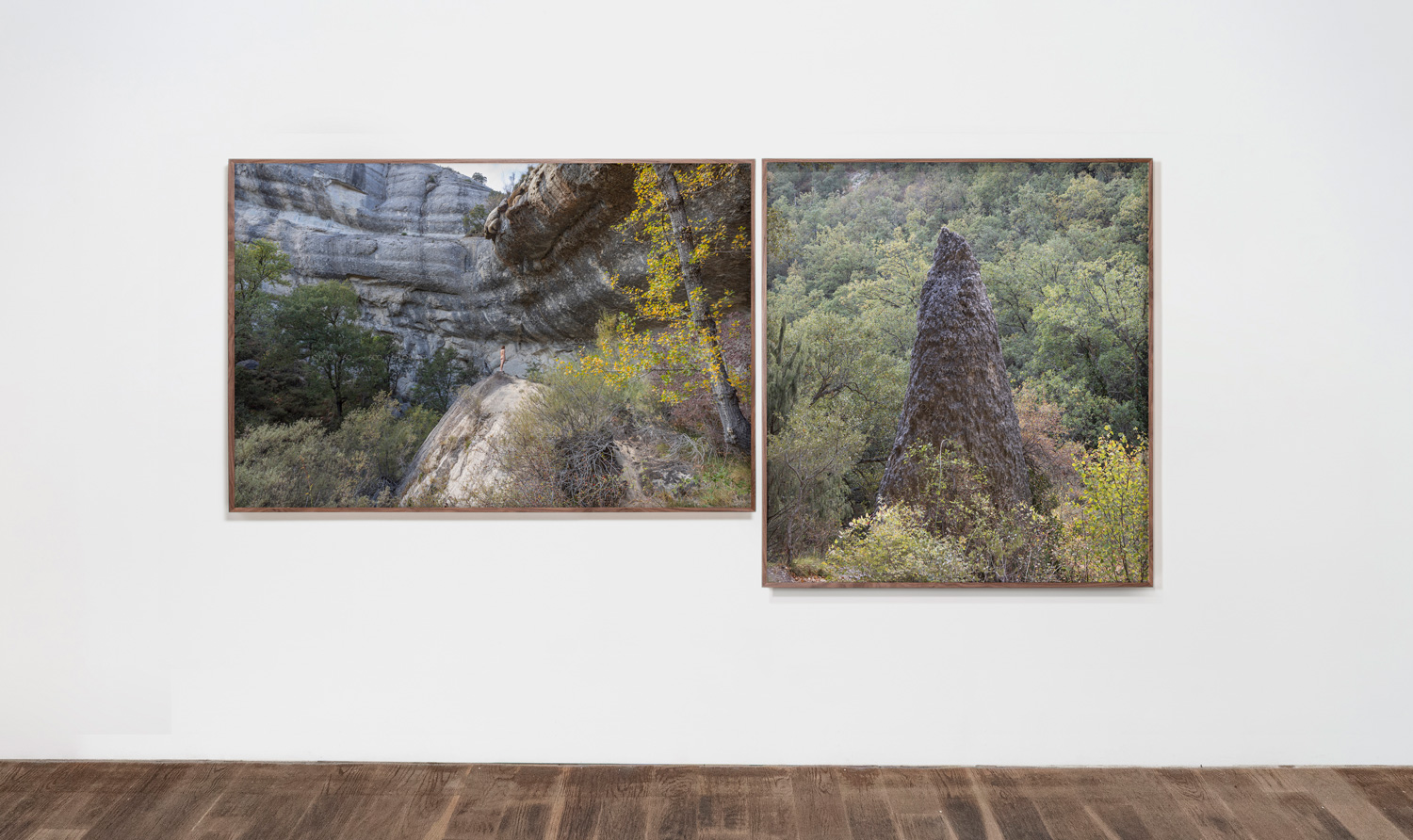
The action is documented through a short film and two large photographs with engraved glass. A first image capturing my body in the middle of this landscape traces the flow of calcium carbonate across the atmosphere, the geosphere and the human body through a series of chemical formulas. The second photograph portrays a stone pyramid with an overlaying engraved glass containing latin names drawn from Aristotle’s Scala Naturae—a hierarchical model of nature that places the human above all other beings and situates geology at the lowest level of material perfection.
By staging the body and landscape as a continuous chemical system, and placing it in dialogue with ancient structures of Western knowledge, the work challenges anthropocentric hierarchical constructions of nature and opens up a space for horizontality, interrelation, and embodied coexistence with the geological substrate of life.
.

Photography and documentation by Carlota Antón and Miguel Sbastida.
..
.
.